Lighting a Melbourne deck without glare or a moth circus
Evenings are the point of a lot of decks. How to light steps, tables and trees so you can see the glass, not the bulb.
By James Calder, Landscape writer · 27 June 2025 · Updated 6 February 2026
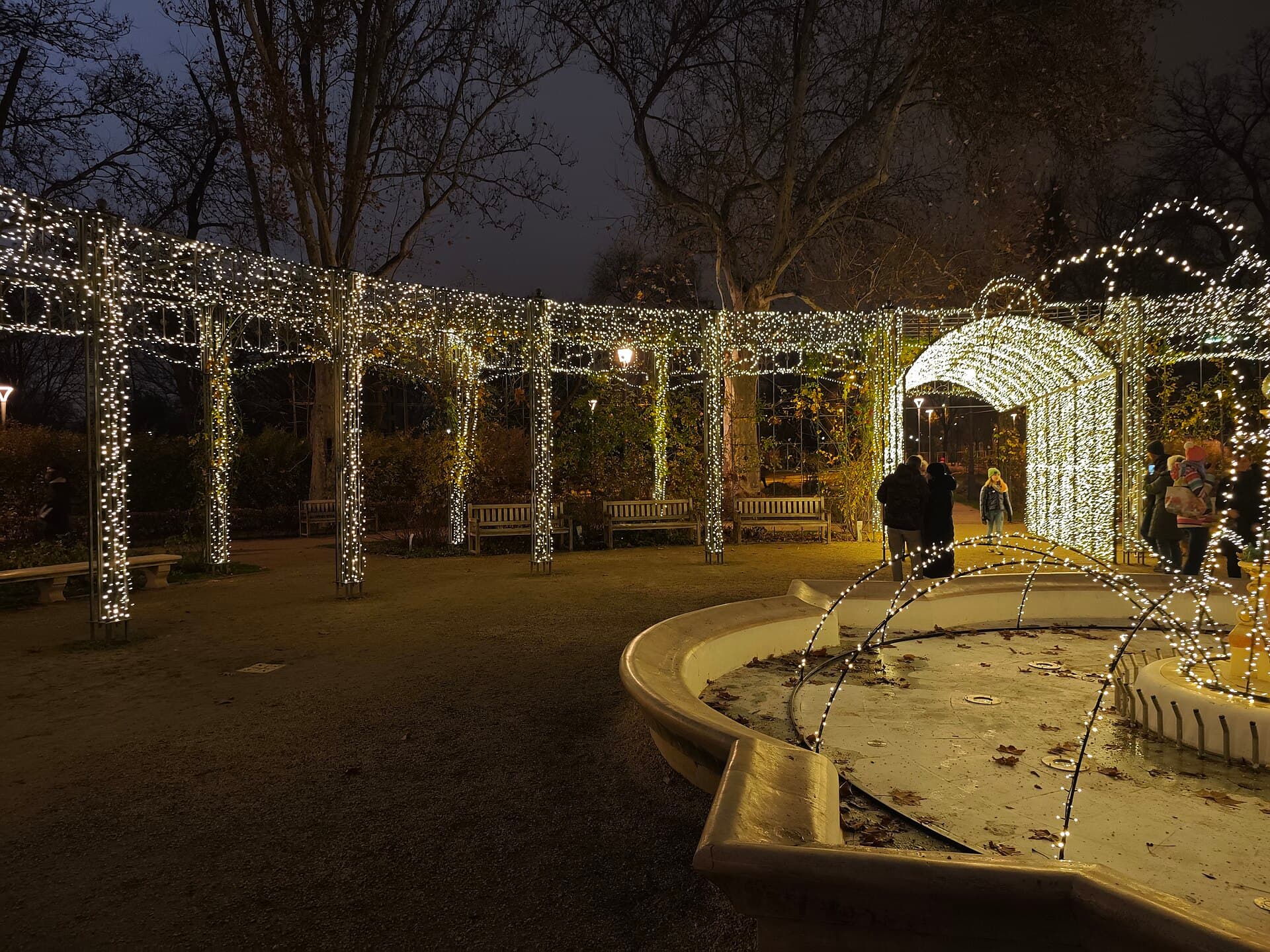
Photograph: Elekes Andor. Városliget, Rose Garden at night, 2025 (4).jpg. CC BY 4.0. Source on Wikimedia Commons. See all image credits.

A deck that dies at dusk is a lunch platform. Melbourne evenings in March and April are why people spend the money. Lighting is how you use the stair, read a face, and not flood the neighbour’s bedroom.
The mistake is a single bright flood on the house wall. The other mistake is thirty cheap spikes that look like an airstrip.
Light the hazard, then the ritual
Stairs and level changes first. A nosing strip, a low riser light, or a shielded step light does more for safety than a festoon. See raised decks. Wet spotted gum in July needs that light more than January does.
Then the table. A dimmable pendant under a pergola, or a wall light that washes a surface rather than a retina, is enough. You want to see the food, not the filament.
Then the garden, if you have one. A tree lit from below is theatre; use it sparingly. A path to the bin is not theatre and still needs a mark.
Colour, glare and the moths
Warm white — in the 2700 to 3000 kelvin band — suits timber and skin. Cool blue-white makes a hardwood deck look like a car park and pulls insects. Shield the source. If you can see the diode from the neighbour’s second storey, you have failed courtesy and comfort.
Avoid uplights on a north-facing house wall that bounce into a bedroom. Avoid fittings that fill with water; Melbourne will test the IP rating you faked.
Festoons are charming and they glare if the bulbs are naked and low. Hang them high, or use them as a party layer on a dimmer, not as the only light.
Wiring, not a meadow of solar graves
A licensed electrician, outdoor-rated cable, and a switch inside the door will beat a drawer of dead solar spikes. If the deck is being built now, run conduit before the boards go down. Retrofitting a cable across finished merbau is a carpenter’s sigh.
Low-voltage landscape systems are fine if they are a system. Mix-and-match transformers are how you get a hum and a dead run.
If the deck is a roof, every light penetration is a waterproofing detail. Surface conduit on a batten, or lights on the house wall, can be cleaner than a constellation of holes.
Winter, timers and the unlit month
Put the lights on a switch you will use, and maybe a timer so the stair is not a well when you come home. Do not leave a flood on all night for “security” that is really habit.
In winter you may want less garden theatre and the same step lights. That is a circuit design, not a new personality.
Good deck lighting is slightly boring: warm, low, repeatable. The timber and the people can be the brightness.
Heaters, insects and the other evening kit
People buy mushroom heaters and then light the deck like a stage. The two fight. A heater wants air; a low roof and a bright pendant make a stuffy glare. Put heat where people sit and light where people walk. Do not do both with one cheap gadget from a hardware end-cap.
Citronella candles are not a lighting plan. They are a smell. If insects are the brief, reduce the cold bright sources first.
Maintenance of the lights themselves
Gaskets fail. Coastal fittings pit. Solar spikes fill with water and grow a science experiment. Once a year, at the same time you wash the deck, check the step lights, the transformer, and the one festoon that has been hanging in a fig.
A dead stair light is a safety issue, not a décor issue. Replace it before the first dinner in the dark.
Evenings are why the deck exists for half the year. Light them like a room you respect: warm, low, and kind to the people next door.
Switches, scenes and the inside-outside join
Put the deck lights on a switch you pass at the door, labelled if you have guests. A scene that dims the flood and keeps the stair is worth a bit of electrician time. Motion sensors on a dining deck will annoy you; motion on a side path to the bins will not.
Match the colour temperature to the kitchen if the stacker is open. A 4000 K kitchen against a 2700 K deck looks like two houses. Aim for a family of warms.
Light is how a Melbourne deck earns its keep after five. Treat it as part of the architecture, not as a drawer of spikes.
Glare into glass and the television test
Open the stacker at night and sit on the sofa. If a deck light sits in the reflection like a headlamp, move it or shield it. A lot of “the deck feels harsh” is one badly aimed wall washer.
Use the house lights as the ambient layer and the deck lights as the specific ones: stair, table, path. When both are at full bright, nobody looks good and the moths throw a festival.
Dimmer from day one. The extra switch is cheaper than a refit.
A Melbourne evening on a good deck does not need much light. It needs the right light in the right place, and the courage to turn the flood off.
Think about the view from the street as well as from the sofa. A deck that glows like a sports field makes the house look nervous and keeps the possums entertained. Shield, warm, and turn it off when you come in. The timber will still be there in the morning, which is more than you can say for a floodlight's welcome. If you only afford one good fitting, make it the stair. The table can live with a candle for a season. The stair cannot live with a guess. Warm, low, repeatable: that is the whole specification. Everything else is decoration you can add when the stair is already safe.
Questions we are asked
- Are solar spike lights enough?
- They are enough to mark a path on a good day and a disappointment after three winters. Hardwired, low-glare fittings on a switch will still be there when you have people to feed.
- Will lights attract every insect in Victoria?
- Warm, shielded, downward light attracts fewer insects than a cold flood. You will still get moths. Do not aim a bright LED at the table from a pergola beam and then wonder why dinner is a nature documentary.
Canonical URL: https://deckingmelbourne.com.au/articles/lighting-deck-melbourne-evenings